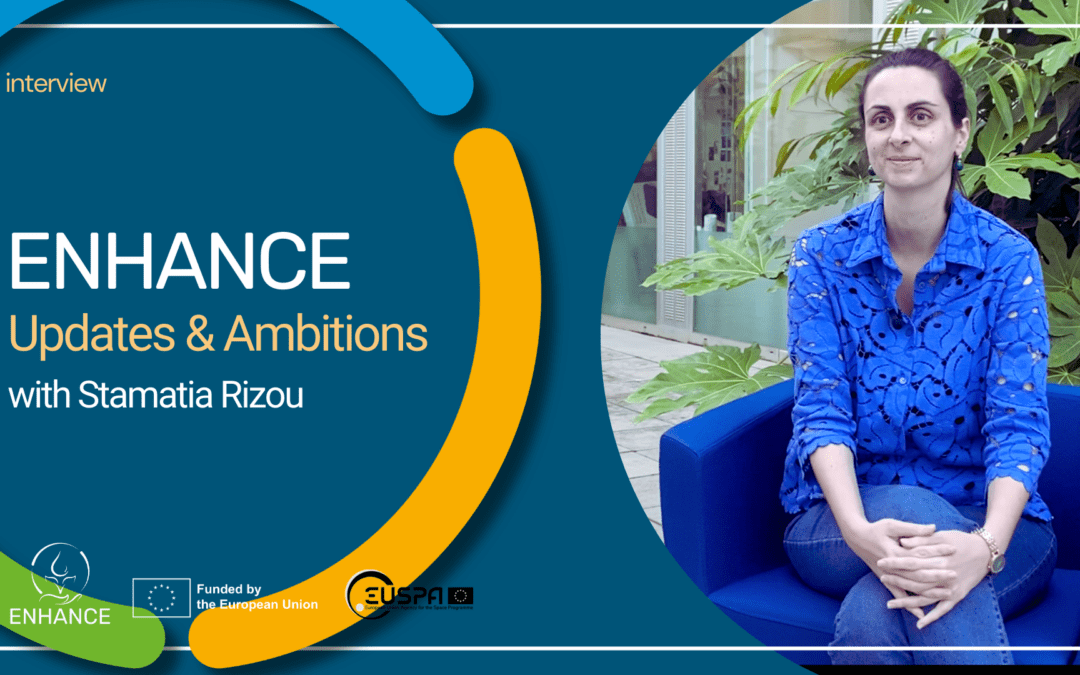
In a newly released video, Stamatia Rizou, Project Coordinator of ENHANCE and R&D Manager at SingularLogic, presents the project’s progress and outlines the next steps in the development of the ENHANCE platform.
First-Year Milestones
During its first year, ENHANCE has achieved several key milestones:
Establishment of Living Labs in two Mediterranean case studies
Identification and engagement of relevant regional stakeholders
Definition of the methodological framework and selection of key indicators
Specification and prioritisation of platform use cases
Initial front-end design and technical architecture development
These foundational activities are shaping the structure and functionality of the ENHANCE platform.
Moving from Design to Development
With the conceptual and methodological groundwork in place, the project now enters a new phase. Development of the core tools is beginning, alongside early validation and evaluation activities that will prepare the ground for pilot implementation in the case study regions.
The upcoming months will focus on translating design specifications into operational digital services capable of supporting sustainable and climate-resilient coastal management.
Coastal areas sit at the intersection of environmental integrity, human health, and economic activity. Yet they are increasingly exposed to climate change, urbanisation, tourism, and agricultural pressures.
Deliverable D2.1 – Development of the ENHANCE One Health Framework for Coastal Management establishes the conceptual and methodological backbone of the ENHANCE project. It defines how the One Health approach is operationalised for coastal environments, recognising the interdependence between ecosystem health, biodiversity, water quality, and human well-being.
The deliverable:
Introduces the ENHANCE One Health conceptual framework
Defines key pressure categories affecting coastal zones (urban, agricultural, and climate extremes)
Maps the links between environmental stressors and impacts on biodiversity and public health
Structures the indicators and analytical components that will underpin ENHANCE tools
Provides the scientific and methodological basis for future validation activities
D2.1 translates the One Health concept into a practical framework tailored to coastal management. It sets the foundation for integrating Earth observation data, citizen-generated data, and advanced analytics into coherent decision-support services.
Within the framework of the ENHANCE project, integrated approaches are being developed to better understand emerging health threats in marine ecosystems. A recent scientific talk highlighted the collaboration between the Institut de Ciències del Mar (ICM-CSIC) and the Universitat Autònoma de Barcelona, focusing on how citizen science can support the monitoring of betanodavirus outbreaks in Mediterranean groupers (family Epinephelidae) under a One Health perspective.
The talk was delivered by Francesc Padrós, from the Department of Animal Medicine and Surgery at the Universitat Autònoma de Barcelona, and presented advances in understanding how this viral disease is affecting marine species and how it can be tracked more effectively.
Monitoring a marine animal health pandemic
In recent years, mass mortality events involving groupers and other fish species have been reported in different areas of the Mediterranean Sea. These events have been associated with betanodavirus, a pathogen responsible for viral nervous necrosis, which causes severe neurological symptoms, including disorientation and loss of balance, often leading to death.
One of the challenges in studying this disease is that outbreaks are highly scattered in space and time. Traditional scientific monitoring alone is often insufficient to detect early signs or to capture the full geographic extent of these events.
Citizen science as a monitoring tool
To address this challenge, researchers are increasingly relying on citizen science. Divers, fishers and other sea users are frequently the first to observe abnormal fish behaviour or mortality events, making them essential contributors to large-scale monitoring efforts.
In this context, the MINKA platform has created a specific project. MINKA enables citizens to report observations of affected fish, upload photographs and record locations and dates. These contributions create a shared dataset that allows researchers to follow the evolution of the betanodavirus outbreak across the Mediterranean coast.
Platforms and citizen communities like MINKA allow to improve spatial coverage and temporal continuity.
Early insights from the data
Preliminary results presented during the talk indicate that citizen science data are already helping to identify patterns in the occurrence of affected groupers. Observations suggest that cases tend to concentrate in specific coastal areas and periods, opening the door to exploring links with environmental conditions such as temperature or local stressors.
While these findings are still exploratory, they provide guidance for directing targeted fieldwork and laboratory analyses, making disease monitoring more efficient and responsive.
This collaboration between ICM-CSIC and UAB exemplifies the One Health approach promoted by ENHANCE, connecting animal health, environmental processes, and societal participation. From another perspective, citizen science platforms like MINKA demonstrate how public engagement can meaningfully support research at the interface of environmental and animal health.
The full talk by Francesc Padrós is available online, in Catalan.
ENHANCE is pleased to announce its participation in Resilient Futures, an international e-Community of Practice (e-CoP) powered by ENRICH GLOBAL under the Thriving Cities and Resilient Communities Thematic Group.
Chaired by Professor Giannis Adamos (Aristotle University of Thessaloniki), Resilient Futures brings together researchers, innovators, policymakers, practitioners, community organisations, and young professionals committed to advancing resilient, inclusive, and sustainable territories. By joining this initiative, ENHANCE strengthens its engagement in collaborative, interdisciplinary dialogue on resilience, sustainability, and evidence-based decision-making.
Coastal and urban-coastal areas are increasingly exposed to climate change, environmental degradation, biodiversity loss, and growing anthropogenic pressures. Addressing these challenges requires integrated responses that connect environmental monitoring, public health, social dimensions, and governance. Resilient Futures provides a collaborative space to foster knowledge exchange and systemic approaches to resilience.
Through its participation in the e-CoP, ENHANCE contributes a strong focus on One Health coastal management, combining Earth observation, citizen science, and advanced data analytics to support sustainable and climate-resilient coastal areas. This approach aligns with the community’s ambition to translate research and innovation into practical tools and policy-relevant solutions.
Areas of Collaboration
Within the Resilient Futures e-CoP, ENHANCE will engage in collaborative activities related to:
Co-creating resilient solutions through participatory and stakeholder-driven approaches
Addressing climate and environmental risks in coastal and peri-urban areas
Integrating environmental, biodiversity, and public health perspectives through a One Health framework
Leveraging Earth observation and citizen-generated data to strengthen decision-making
Supporting policy dialogue on sustainable and climate-resilient territorial development
Connecting researchers, policymakers, practitioners, and civil society across Europe and beyond
These priorities directly reflect ENHANCE’s mission to deliver integrated data services and decision-support tools for coastal management.
What This Means for ENHANCE
Participation in Resilient Futures offers ENHANCE a valuable platform to share project methods, case studies, and results, while learning from complementary initiatives worldwide. It also creates opportunities to:
Strengthen cross-sectoral and interdisciplinary collaboration
Engage with international experts working on resilience and sustainability
Exchange practices and tools relevant to coastal and urban-coastal contexts
Contribute to policy-oriented discussions at European and global levels
Join the Community
Resilient Futures is an open and evolving community that values diverse perspectives and experiences. ENHANCE encourages its partners, stakeholders, and wider network to engage with the e-Community of Practice and contribute to more resilient and sustainable futures for coastal and urban environments.
The ENHANCE project has released a new short video introducing its mission to support sustainable and resilient coastal management across Europe.
The video highlights how ENHANCE combines AI-driven analytics, Copernicus satellite data, in-situ observations, and citizen science within a One Health framework that links environmental, human, and animal health. It also presents the project’s key innovations, including its data exchange platform, AI-powered One Health Toolkit, and stakeholder-driven Living Labs.
Featuring real-world case studies in Spain and Greece, the video demonstrates how ENHANCE is addressing pollution, climate-driven risks, and ecosystem degradation in coastal areas.
Funded by the European Union and running from 2024 to 2027, ENHANCE brings together seven partners from four countries to advance science-based, data-informed decision-making for Europe’s coasts.
▶️ Watch the video to learn how ENHANCE is transforming coastal monitoring and management.
As SingularLogic, coordinators of the ENHANCE project and leaders in the co-design of its One Health toolkit, we are proud to share that the project has achieved one of its first key milestones: the identification of the use cases that will guide the toolkit’s development.
This milestone was reached through a co-creation methodology, built on a phased, iterative approach that places stakeholders at the heart of digital tool development for coastal management.
Laying the Groundwork Through Iterative Stakeholder Co-Creation
Our co-creation process began with groundwork: together with our project partners and stakeholders we defined user personas, which represent the diverse groups affected by coastal ecosystem challenges. These personas were then used to generate user stories—concise scenarios that articulate real needs and goals. Through workshops and multiple feedback loops, we refined these stories into concrete user requirements, ensuring that every aspect of the platform reflects the realities of those who will use it.
This participatory design is reinforced by multiple rounds of workshops, where stakeholders validate and prioritize requirements, test early prototypes, and provide input on usability and accessibility. The iterative nature of the process means that each phase builds on the last: initial user flows and service descriptions are enhanced through stakeholder feedback, and demo versions of the toolkit are subjected to structured usability assessments.
This ensures that the final product is not only technically robust but also intuitive and accessible to a wide range of users, from municipal officers and aquaculture professionals to educators and citizen scientists.
Figure 2: Co-creation session of Case Study 2 (Pagasitikos Gulf, Volos, Greece)
From Insights to Action: Identifying Eight Use Cases
Thanks to this collaborative journey, we identified eight use cases representing key aspects of coastal management under the One Health framework. The first two use cases focus on visualization and monitoring: providing real-time water quality alerts and fostering citizen participation in environmental monitoring.
The next four address sustainable management and risk assessment, enabling stakeholders to visualize One Health indicators for urban beaches, support sustainable aquaculture, monitor protected areas, and generate dynamic coastal risk maps for policy regulation.
The final two use cases center on training and education, offering formal and non-formal learning tools that leverage real-world data and citizen science to build environmental literacy and support eco-tourism.
Building a Toolkit for the Future of Coastal Management
Together, these use cases illustrate the breadth and depth of the ENHANCE toolkit’s ambition. By weaving together stakeholder input, technical innovation, and a commitment to participatory design, the project is setting a new standard for digital solutions in coastal management.
The co-creation methodology ensures that every feature and function is shaped by those who will use it, resulting in a platform that is not only effective in addressing environmental and health challenges, but also inclusive, adaptable, and ready to evolve with the needs of its community.
Conclusion
Through an iterative, stakeholder-driven process, the ENHANCE project has built a solid foundation for its One Health digital toolkit. The eight identified use cases reflect real needs across monitoring, sustainable management, policy support, and education. By grounding every step in co-creation, ENHANCE is developing a toolkit that is practical, inclusive, and adaptable, and well-positioned to support the future of coastal management.
Author(s) Bio:
Antonia Vronti: R&D Project Manager, SingularLogic, bringing solid background in Social Sciences and experience managing a range of projects. She focuses on service co-design, organising and hosting workshops that bring stakeholders together for meaningful discussions on design, functionalities, and features. Her commitment to co-creation drives the development of user-centred solutions that meet stakeholder needs and deliver tangible outcomes.
Dr. Stamatia Rizou: R&D Manager, SingularLogic leading a multidisciplinary team in data technologies and AI applications. She holds an Electrical and Computer Engineering degree from NTUA and a PhD in distributed systems from the University of Stuttgart. With over 10 years of experience in EU-funded research, she has been a Marie-Curie fellow, co-supervised multiple PhD students, and currently coordinates and leads research in EU projects across various sectors. She has also served as an expert evaluator for the EU’s H2020 and Horizon Europe programmes.